An MBTA Stop with a Cafe? Tufts Students Win Heavy Civil Competition
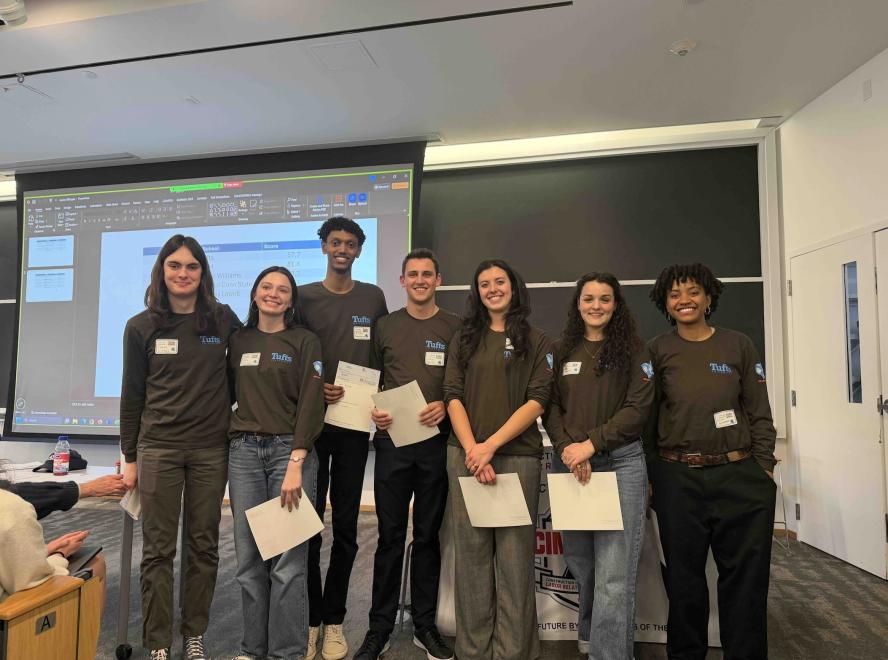
For most people, taking the T is a relatively mundane experience—commuters board the subway every day, likely without thinking twice about how it got there. But for a team of seven School of Engineering civil and environmental engineering students who recently won a competition designing a hypothetical MBTA stop, they may never look at a subway the same way.
On April 11, undergraduate students Ashley Forkey, Adda Hennessey, Ethan Kessler, Sanaa Nicolson, Ella Voorhees, Oakley Winters, and Bisrat Yismashewa (all E26) participated in a heavy civil infrastructure student competition hosted on Tufts’ Medford campus. They won first place and received a $15,000 prize competing against eight teams. The event, facilitated and funded by the Construction Industries of Massachusetts-Labor Relations Division (CIM-LRD), strives to attract engineering students to the heavy construction industry while fostering creativity and strong work ethic.
The heavy lifting behind a subway stop design
The competition tasked students with designing a T station near Allston Landing, which is part of an imagined extension to the MBTA Blue Line.
“This year, the setting of the design challenge was different,” explained Lucy Jen, professor of the practice and co-mentor alongside alumna Alison Bulman (E11) for the Tufts team. “In previous years of the competition, students designed T stations in downtown Boston, where there are a lot of building constraints. This year, the design site was located in a vacant lot—essentially a blank canvas.”
This gave the team more creative freedom to think outside of the box. But a lot of research is involved before an engineer can begin to design anything—especially something as technical as a subway stop.
“We spent the end of the fall semester researching everything we could about the site,” explained Kessler. “We had to figure out who owns the land and the conditions of the site, including soil stability and underground utilities. We used Google Earth to get a sense of the location and visualize the setting, meeting weekly to discuss our findings.”
In a field as detail-oriented and complex as heavy civil engineering, getting caught up in small details is inevitable. One of the team’s strengths was balancing the “bigger picture” in addition to these technical aspects of the task. “We focused a lot on detail,” Hennessey said. “But we also were able to zoom out and ask ourselves, ‘What do people actually want in a T stop?”
With this in the back of the team’s mind throughout the design process, the students differentiated themselves with a focus on accessibility, architecture, and the aesthetics of the station. Their design included a mural, a cafe, safety features, and charging stations– additions that were integrated while also saving construction costs, making their ideas stand out.
Leading through challenges and changes with personality
Each student focused on one element of the project but continuously had to step outside their comfort zone to check and understand each other’s work.
“Our mentors really trusted our abilities to address challenges,” Hennessey explained. “If they [our mentors] noticed a problem, they would point it out, but it was up to us to solve it. This allowed each of us to feel like we were leading the project in some way and that we really had a stake in it.”
The project also shed light on just how interconnected the elements of engineering are. If, for example, a geotechnical detail was changed, this small alteration would also change the cost, modeling, and other aspects of the project.
“We made a change to our design right before the project was due,” Kessler said. “Everything had to be updated because everything goes hand-in-hand. Even work we had done five months ago came back into focus.”
The competition involved a 25-minute oral presentation during which each team presented their design to a panel of professional engineers, other participants, and family and friends. With extensive practice in front of professors, as well as friends and family without an engineering background, the team ensured that their presentation told a cohesive, easy-to-understand story, all while bringing their personalities to the competition.
Their $15,000 prize will support the Department of Civil and Environmental Engineering.
“The engineering industry foresees a shortage of heavy civil engineers,” explained Jen. “We want to support interested students as much as we can.”
Learn more about the Department of Civil and Environmental Engineering.
Department:
Civil and Environmental Engineering